
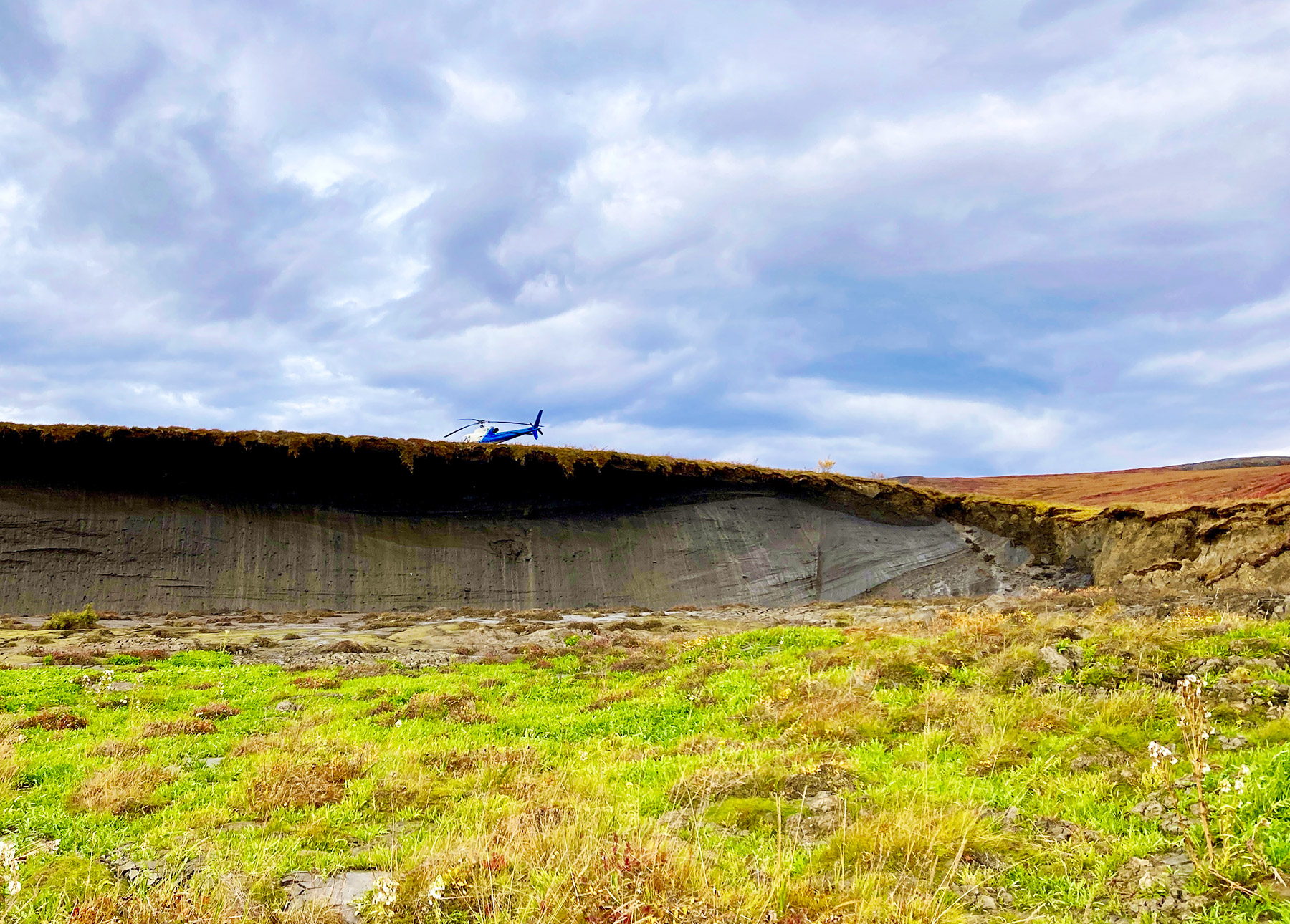
Photo: Headwall of a thaw slump with helicopter, Peel Plateau, Canada. Credits: Carolina Voigt, AWI (2025).
Project: Knowledge Gaps and Challenges
Across the Arctic, climate change and human activities are increasingly destabilizing permafrost landscapes and triggering rapid thaw processes. In ice-rich regions, collapsing ground, thermokarst lake growth, thaw slumps, and erosion can dramatically reshape entire landscapes within only a few years or decades. Previously frozen carbon-rich deposits become available for decomposition and greenhouse gas release. Yet major uncertainties remain regarding where rapid thaw occurs, how much carbon becomes vulnerable, and how strongly these emissions may amplify climate change and affect the remaining global carbon budget for keeping warming below 2°C.  addresses this challenge by closing these three major knowledge gaps:
Rapid Thaw Dynamics in Ice-Rich Permafrost (Gap 1)
Rapid Thaw Dynamics in Ice-Rich Permafrost
Where, how fast, and how deep does rapid permafrost thaw take place? What role does ground ice distribution play?
Where, how fast, and how deep does rapid thaw occur?
Rapid thaw processes can dramatically reshape Arctic landscapes. Ice-rich permafrost may collapse, forming thermokarst lakes, thaw slumps, erosion features, and subsiding ground. However, detailed information about where these processes occur, how quickly they develop, and how they may evolve under future climate change are still missing.
One major challenge is the limited knowledge about the distribution of ground ice – a key factor controlling landscape collapse and thaw dynamics.
How addresses this challenge
combines satellite observations, field measurements, and deep learning methods to map rapid thaw processes and improve estimates of ground ice distribution across the pan-Arctic region. Historical and modern satellite imagery will help track landscape changes over several decades, while process-based models will simulate future thaw dynamics under different climate scenarios.
Reactivity of Rapidly Thawing Organic Carbon (Gap 2)
Reactivity of Rapidly Thawing Organic Carbon
Where, how much, and what type of organic matter is thawed? What are the consequences for greenhouse gas fluxes?
What happens to carbon released from thawing permafrost?
Permafrost soils contain organic matter that has remained frozen for thousands of years. When thaw occurs, microbes can decompose this material and release greenhouse gases such as carbon dioxide and methane. However, it is still unclear how much carbon becomes available, how quickly it decomposes, and how environmental conditions influence these emissions.
Another open question is how thawing carbon moves through Arctic landscapes – from soils into lakes, rivers, and aquatic systems - and how this affects greenhouse gas production.
How addresses this challenge
will investigate how different forms of thawing permafrost organic matter decompose and release greenhouse gases across Arctic regions in Alaska, Canada, and Finland. We will combine existing sample collections with new, undisturbed permafrost samples from selected field sites and carry out extensive measurements of greenhouse gas production and in-situ CO₂ and CH₄ fluxes across different thaw environments.
Emission Contribution and Global Consequences (Gap 3)
Emission Contribution and Global Consequences
Is the strength of the permafrost carbon–climate feedback underestimated? What is the effect on the remaining C budget?
How will rapid thaw affect future climate change?
Rapid permafrost thaw is currently not represented in most Earth System Models. This means that future greenhouse gas emissions from Arctic landscapes – and their contribution to global warming – may currently be underestimated.
A key question is whether additional emissions from thawing permafrost could substantially reduce the remaining global carbon budget available for limiting warming to internationally agreed climate targets.
How addresses this challenge
develops new model approaches to include rapid thaw processes and associated greenhouse gas emissions in next-generation Earth System Models.
In detail, we will investigate how additional releases of CO₂ and CH₄ from collapsing permafrost landscapes may alter biogeochemical feedbacks and future climate trajectories. New process understanding from Challenges 1 and 2 will guide the representation of rapid permafrost thaw processes in the land component of the ICON Earth System Model.
The resulting datasets and simulations will support international climate assessments and help inform future policy discussions.