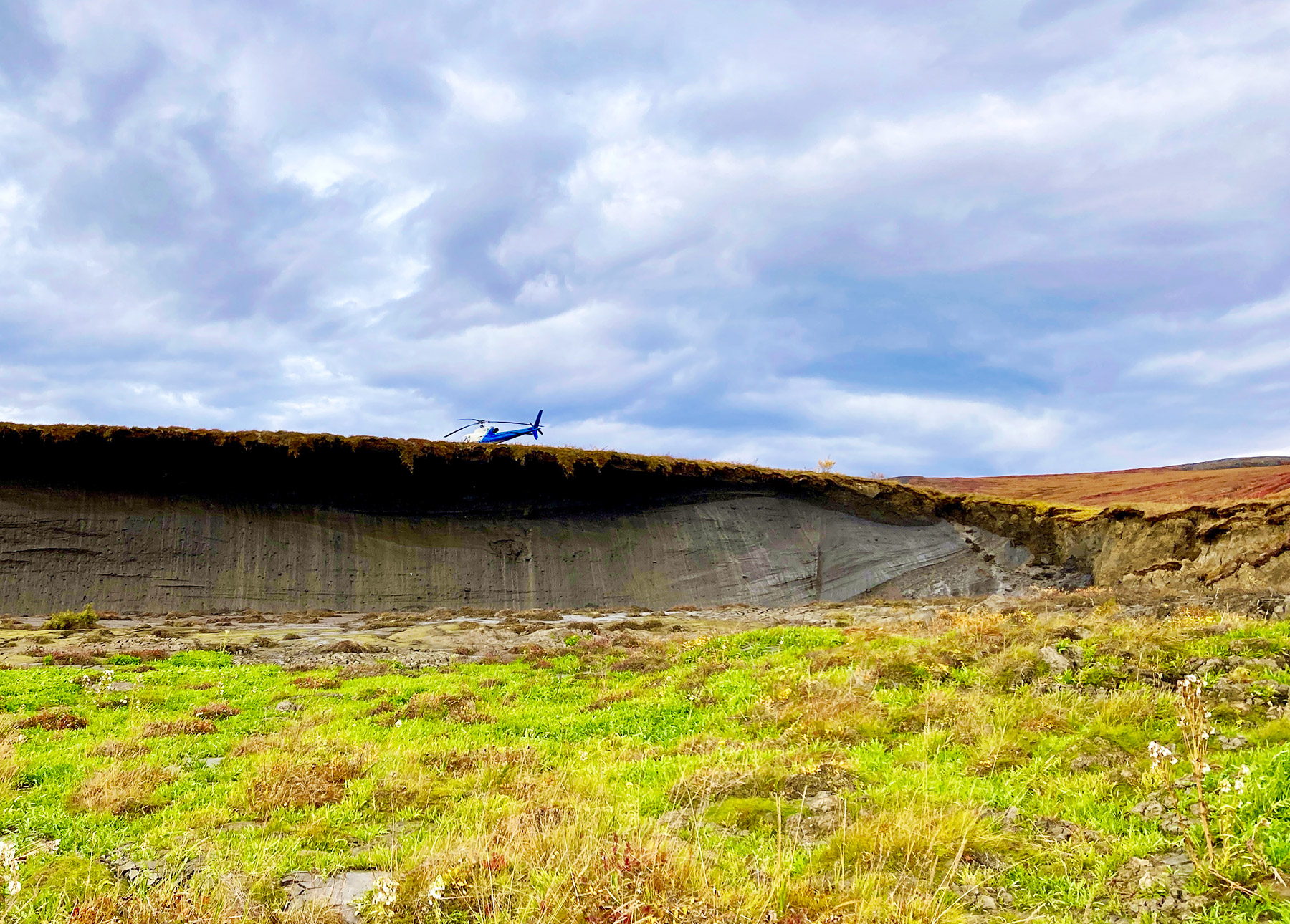
Headwall of a thaw slump with helicopter, Peel Plateau, Canada. Credits: Carolina Voigt, AWI (2025).
About the  Project
Permafrost soils in the Arctic store enormous amounts of organic carbon – more than currently found in the atmosphere. As the Arctic warms, frozen ground begins to thaw, potentially releasing large quantities of carbon dioxide (CO₂) and methane (CH₄) into the atmosphere and accelerating climate change.
While gradual permafrost thaw has been studied for decades, much less is known about rapid thaw processes such as thaw lakes, thaw slumps, erosion, and ground collapse. These abrupt landscape changes can expose deep, carbon-rich soils and trigger strong greenhouse gas emissions, yet they are still poorly represented in current Earth System Models.
brings together an international team of experts in permafrost science, greenhouse gas biogeochemistry, remote sensing, artificial intelligence, and climate modeling to better understand how rapid permafrost thaw affects the global carbon cycle and future climate trajectories.
Using field observations, satellite data, deep learning, laboratory experiments, and next-generation Earth System Models, will investigate where rapid thaw occurs, how much carbon becomes vulnerable, and how these emissions may alter the remaining global carbon budget for meeting climate targets.
The project will provide urgently needed scientific data and model-based insights for the research community, climate assessments, and decision-makers.
Knowledge Gaps and Challenges
Rapid Thaw Dynamics in Ice-Rich Permafrost
Where, how fast, and how deep does rapid permafrost thaw take place? What role does ground ice distribution play?
Reactivity of Rapidly Thawing Organic Carbon
Where, how much, and what type of organic matter is thawed? What are the consequences for greenhouse gas fluxes?
Emission Contribution and Global Consequences
Is the strength of the permafrost carbon–climate feedback underestimated? What is the effect on the remaining C budget?
More about gaps and challenges
Work Packages
Seven partner institutions from five countries are organized across seven work packages that together form . Learn more about our distributed research activities and the collaborators involved.