
Headwall of a thaw slump along the Miner River, 85 km southeast of Tuktoyaktuk, NWT, Canada. Credits: Carolina Voigt, AWI (2025).
News: Sailing and Science: It's the Cryogrid Hackathon Held at Sea
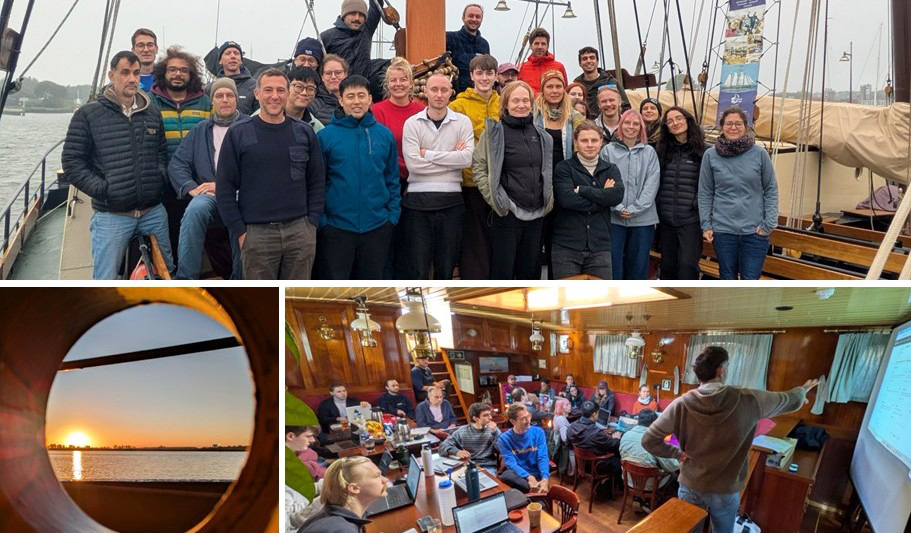
CryoGrid Hackathon sets Sail with ITCH 2026
A sailing boat is not your usual hackathon venue – but it was the setting for the 8th edition of ITCH (IT's the CryoGrid Hackathon). From 11 to 16 October 2026, 30 researchers gathered in the Netherlands to exchange ideas on CryoGrid, permafrost modelling and broader cryosphere research. Held in collaboration with  , the workshop welcomed participants from across the project, as well as researchers already working with CryoGrid or interested in using it in the future.
The first two days were dedicated to scientific presentations, with around two-thirds of the participants sharing their recent work or plans for future research. The talks covered a range of research projects, many using CryoGrid (Lite) to model specific permafrost processes and research questions. Others focused on different models or broader topics in permafrost research. Twelve participants were early career researchers (ten PhD candidates and two master's students). The group also included representatives from all but one of the partner institutions and nearly all work packages, offering a chance to hear what others are working on across the project.
On Wednesday, the focus shifted to smaller-group discussions. Four breakout groups explored mountain permafrost and hillslope processes, vegetation and fire, ground ice and thermokarst, and salt, contamination and hydrogeology. These sessions allowed participants to dig into specific processes, compare approaches and discuss open questions in permafrost research and modelling. Discussions continued on Thursday, both one-on-one and in smaller groups.
Of course, the boat was more than just a place to hold the workshop. Between sessions, we sailed across the IJsselmeer, and when needed, everyone pitched in on deck. After several days of science and sailing, it was time to return to Enkhuizen. Those who stayed until the end rounded off the week with a Dutch lunch near the harbour, including fries that our local expert assured us were the best in the Netherlands.
ITCH brought together researchers at different career stages, from different institutions and with different levels of experience with CryoGrid. It was a chance to share ongoing work and get to know fellow researchers beyond individual projects. We look forward to seeing where these conversations lead and to the next edition of ITCH!
CB