

Headwall of a thaw slump along the Miner River, 85 km southeast of Tuktoyaktuk, NWT, Canada. Credits: Carolina Voigt, AWI (2025).
News: A Long Field Season Successfully Completed in Northern Finland
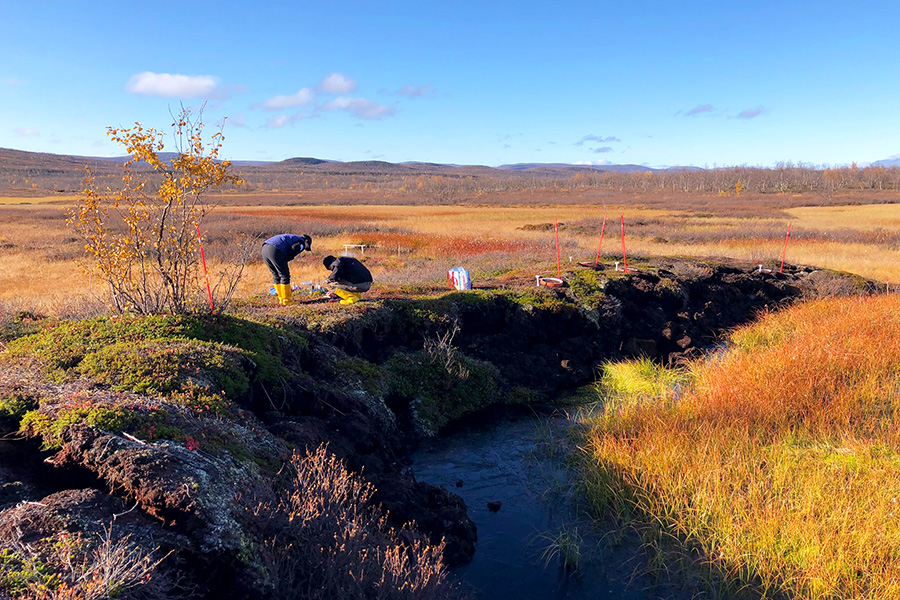
Chamber measurements taken by Fabian Seemann and Mia Teichert at Peera palsa (Photo by F. Neiske).
Fieldwork in Kilpisjärvi, northernmost Finland, carried out by AWI and the University of Hamburg spanned three individual campaigns this year: the first in June, the second in July/August, and the last in September. Together, these three legs allowed the team to conduct fieldwork under a wide range of conditions, from early summer to late autumn, from polar day to the autumnal equinox, and across different activities of plant photosynthesis.
The campaigns were carried out together with the partner project COLDSPOT. In June during leg 1, Carolina Voigt, Christian Knoblauch, and Friederike Neiske joined to select field sites for  . In Leg 2, PhD student Carolin Frauhammer continued the fieldwork alongside Friederike Neiske, extending the manual greenhouse gas measurement programme. In the final leg in September, Friederike Neiske, Fabian Seemann and Mia Teichert completed the season’s measurements.
For the project, measurements were conducted at two permafrost peatlands, Peera palsa and Saarikoski, where abrupt thaw is causing the subsidence of palsas (permafrost mounds) and the development of permafrost-free, inundated mires. These gradients are of particular interest to , as the environmental changes they bring about - shifting soil temperatures, moisture regimes and vegetation compositions - closely track the progression of permafrost thaw. Accordingly, thaw gradients spanning from palsa tops, across their slopes, to the inundated areas were investigated throughout the season as part of Carolin Frauhammer’s PhD project.
Manual chamber measurements of CO2, CH4 and N2O fluxes along these gradients help to differentiate whether the resulting habitat shifts act as sinks or sources of greenhouse gases. These flux measurements were complemented by soil sampling for biochemical and microbial laboratory analyses, allowing the team to link the observed gas fluxes to the underlying soil processes driving them.
FS