

Headwall of a thaw slump along the Miner River, 85 km southeast of Tuktoyaktuk, NWT, Canada. Credits: Carolina Voigt, AWI (2025).
News: Hundreds of Gas Measurements During Canada’s Arctic Field Season
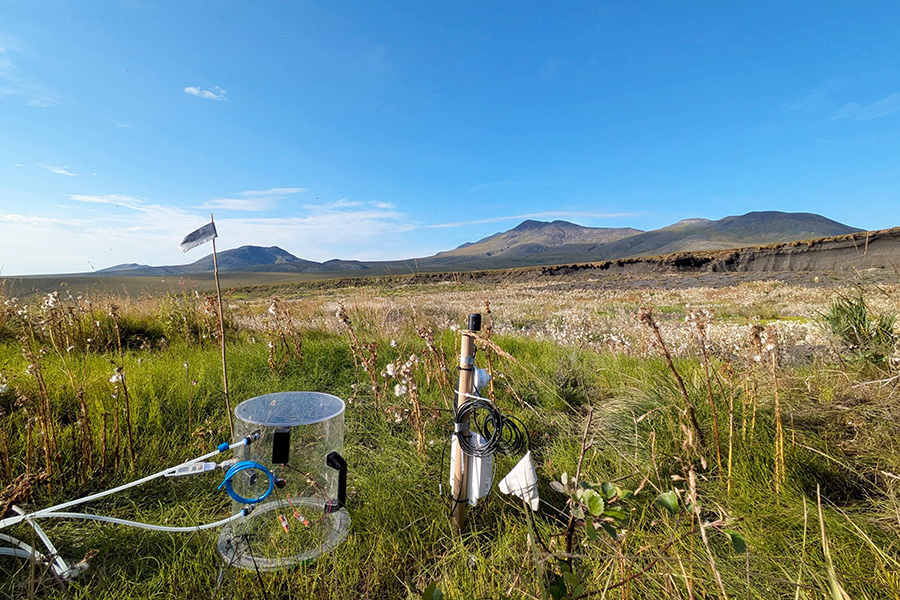
Flux measurements in the Peel Plateau region (Photo by C. Frauhammer).
Fieldwork in Canada kicked off at the end of June, when Gabrielle Hatten and Suzanne Tank from the University of Alberta began investigating lateral gas fluxes from peatlands and thaw slump features near the Miner River and across the Peel Plateau. They also collected soil samples for colleagues at the University of Hamburg involved in the  project.
August marked the peak of the Canadian field season. The team led by Suzanne and Gabrielle was joined by Melanie Burnett, David Olefeldt and Duane Froese. Together, they expanded their flux measurements, completed Electrical Resistivity Tomography (ERT) transects and established a new “sentinel” site as part of a pan-Northwest Territories (NWT) monitoring network.
Meanwhile, in the regions around Inuvik and Yellowknife, Mike Palmer from the NWT Aurora Research Institute and Bertram Raventlow collected greenhouse gas samples from more than 80 thaw lakes across a range of land-system types.
Another team from the University of Hamburg, Carolin Frauhammer, Carolina Voigt, Ruud Rijkers and Christian Knoblauch, completed its first field campaign in the Northwest Territories. The researchers collected plant, litter and soil samples and conducted flux measurements to investigate the degradation of permafrost carbon following plant regrowth on retrogressive thaw slumps in the Mackenzie Delta and Peel Plateau regions (Photo).
Fieldwork by the University of Alberta teams continued into late September. The researchers measured lateral fluxes at additional sites within established thermokarst peatlands across southern NWT and northern Alberta, complementing these measurements with initial greenhouse gas assessments. Further fieldwork took place in the Sahtu Region, including the central Mackenzie River Valley and the Redstone River area.
From peatlands and thaw slumps to thaw lakes, the 2026 field season in Canada was intense and successful. The teams returned with plenty of samples and data to work on, while the tundra first turned colorful and then white …
JL