

Headwall of a thaw slump along the Miner River, 85 km southeast of Tuktoyaktuk, NWT, Canada. Credits: Carolina Voigt, AWI (2025).
News: Between Steppe and Mountains:  at the Asian Conference on Permafrost
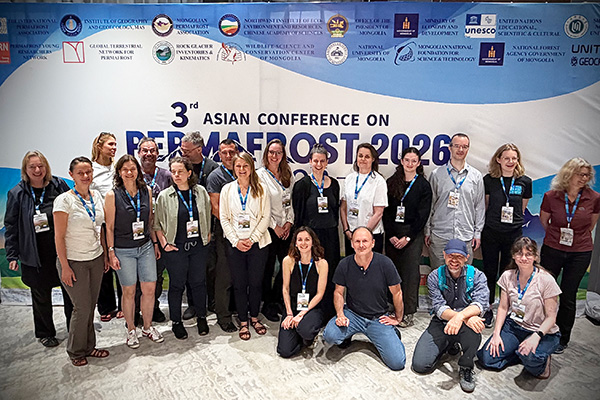
PeTCaT Team members at the 3rd Asian Conference on Permafrost.
The 3rd Asian Conference on Permafrost brought together approximately 350 scientists, engineers and students from around the world in Ulaanbaatar, Mongolia, from 28 June to 2 July 2026. Set between vast steppes and mountainous landscapes, the conference provided an opportunity to exchange the latest research findings and discuss the future of permafrost science. Members of the team contributed in several capacities, presenting their research and advancing discussions on science communication and knowledge exchange.
Ahead of the conference, the Global Terrestrial Network for Permafrost (GTN-P) Workshop focused on recent developments and the network’s new Data Platform. Tillmann Lübker, Project Manager and Technical Director of GTN-P, was one of the organizers and contributor to the workshop.
During the conference, Tillmann presented the online tool in a talk entitled “Communicating Pan-Arctic Permafrost Landscape Change to Non-Specialist Audiences Using the Arctic Landscape EXplorer (ALEX).” The presentation was part of a session dedicated to outreach, entitled “Communicating Permafrost Science: Knowledge Transfer through Education, Outreach, and Participatory Research,” led by Josefine Lenz, ’s Communication Coordinator.
Josefine also presented work on the co-creation of permafrost knowledge through youth engagement. Her presentation sparked discussions with participants about ways to strengthen climate literacy and make permafrost science more accessible to younger generations.
Other contributions from the Alfred Wegener Institute (AWI) included Anne Morgenstern’s presentation of results on surface water chemistry in northwestern Alaska and Lutz Schirrmeister’s poster on palaeoecological research and climate reconstruction in northeastern Siberia.
The conference was rounded off by a cultural program and local excursions, offering participants a unique opportunity to discover Mongolia’s diverse landscapes and explore environments shaped by permafrost. These activities combined scientific exchange with valuable insights into the regional landscapes and contexts that make permafrost research so important.
A special highlight was the announcement of the IPA Lifetime Achievement Award to Vladimir Romanovsky, Professor Emeritus at the University of Alaska Fairbanks (UAF), in recognition of his outstanding contributions to permafrost science. Congratulations to Vladimir on this well-deserved honor!
JL